A living heritage
The monasteries belong to a long Orthodox tradition. Their extraordinary setting is only part of the story, interiors and religious life deserve the same attention as the panorama.

THESSALY · BETWEEN ROCK AND SKY
A landscape that makes you stop mid-sentence.
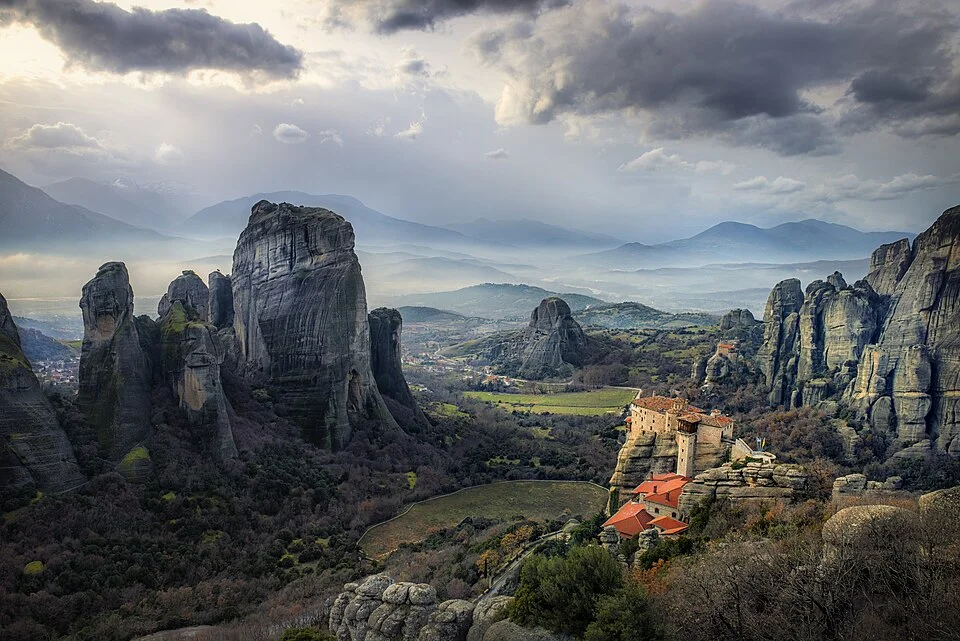
Stone towers rise above the plain, with monasteries perched on their summits. Meteora is both a remarkable landscape and a living religious place, best enjoyed with time for the views and respect for the communities.
Meteora’s religious history developed within an unusually demanding landscape. Hermits were living among the rock formations before monasteries grew into larger communities during the later medieval period. Churches, domestic buildings and terraces had to be accommodated on limited high ground, producing a close relationship between natural form and built space. The continuing Orthodox communities are central to the meaning of the ensemble, alongside the architecture and the broad views.
The monasteries belong to a long Orthodox tradition. Their extraordinary setting is only part of the story, interiors and religious life deserve the same attention as the panorama.

A rushed circuit can become a succession of car parks and stairs. Pick the monasteries you most want to visit, leave room for the approach, and let the landscape be an experience in its own right.
Opening days differ between monasteries. Check current hours and dress requirements for each one, and ask about access before arrival. There are steps at many sites. Photography restrictions inside must be respected.
Official tickets & current arrangements ↗Stay in Kalambaka or Kastraki, then plan the road or guided walking approach. The monasteries are spread across the rocks, not a single walk-through complex. Do not follow unmarked paths towards cliff edges.
Meteora visitor information, Kalambaka, ThessalyMonasteries and rock formations at Meteora. Photo: Stathis floros · Wikimedia Commons · CC BY-SA 4.0. Resized to WebP; cropped for display.
Published October 26, 2026. Read the operator’s current notices before booking.
Attraction descriptions and photograph credits reviewed October 30, 2026.