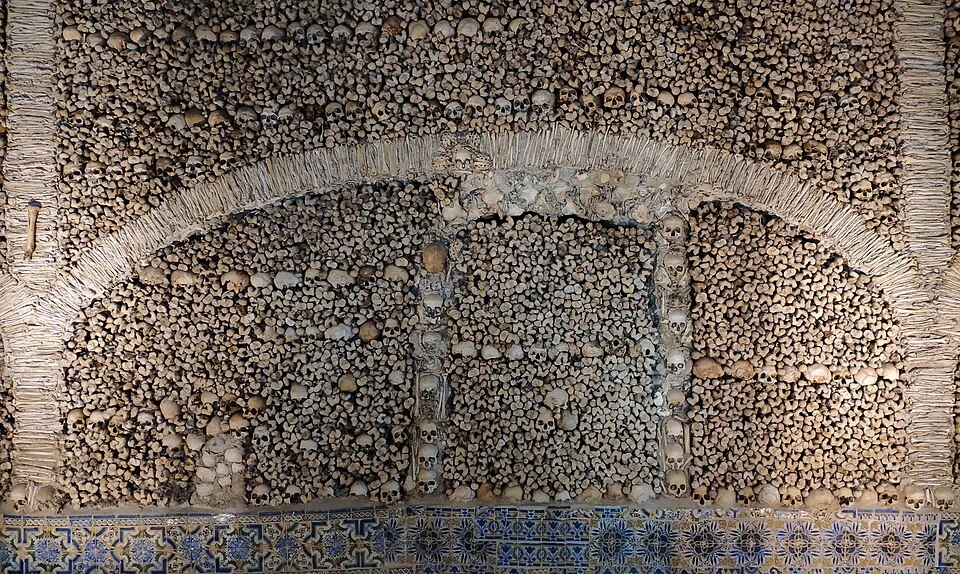
At São Francisco in Évora, walls and pillars lined with human bones turn a small chapel into an encounter with mortality. The detail is startling, but the intention is reflective. This is a religious place made to remind the living that life is temporary.
The chapel belongs to the wider São Francisco complex, whose history links Franciscan religious life with the royal presence in Évora. Its striking material is only one part of that setting. Looking at the chapel’s patterned construction, the painted vault and the surrounding church gives this encounter with mortality an architectural and devotional context.
The Chapel of Bones was created in the seventeenth century within the São Francisco complex. Human bones form part of its walls and pillars, making the idea of mortality impossible to ignore. The famous message above the entrance addresses the visitor directly, a sober invitation to reflect rather than a promise of a macabre spectacle.
The seventeenth-century builders used bones and skulls from burial spaces associated with the convent to create a deliberate Christian meditation on life’s transience. The material is arranged across both walls and pillars, so that the room’s structure remains visible beneath its startling surface. It was a consciously designed religious space, not an archaeological burial chamber.
Enlarge photoFaçade and porch of São Francisco church in Évora, the chapel’s wider setting. Photo: Kent Wang · Wikimedia Commons · CC BY 4.0. Cropped for display.
Look closely, visit thoughtfully
Give yourself time to notice the arrangement of the bones and the small scale of the room. Keep voices low and follow the current photography rules. There is no need to sensationalise what is already a powerful place. For some visitors, especially younger children, the subject may be uncomfortable, an ordinary church or city walk is a perfectly good alternative.
The vaulted ceiling’s paintings, dated 1810, add biblical references and symbols of the Passion to the earlier room. Beyond the chapel, the surviving church reflects rebuilding supported by successive Portuguese monarchs. This contrast between painted overhead imagery, bone-lined supports and the larger church helps explain the site as a layered religious foundation.
Make the visit work for you
Tickets, access & reservations
Check the official São Francisco visitor circuit, opening notices and ticket arrangements. The chapel and other exhibition spaces may have different access conditions from the church itself. Ask directly about step-free access and group visits. Prepare children for the fact that the bones are real human remains.
Go to the São Francisco complex at Praça 1º de Maio, 7000-650 Évora, inside the historic centre. It is the Évora chapel, not another Portuguese chapel with the same name. Combine it with a walk through the city and arrange the final transfer from the railway station separately.