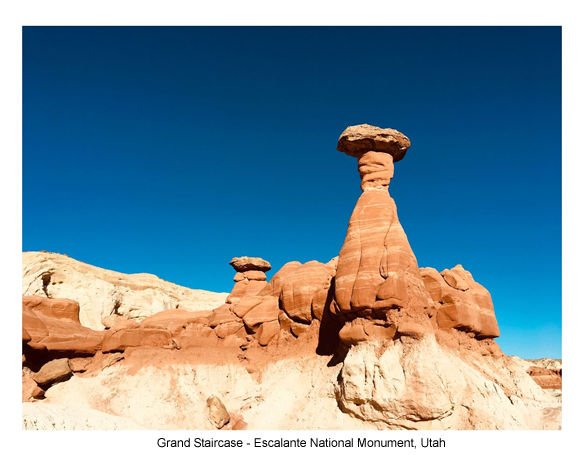
Grand Staircase - Escalante National Monument, Utah
 Location
This new National Monument, established in 1996, occupies 1.7 million acres
of southern Utah, bordered by Capitol Reef National Park to the northeast,
Glen Canyon National Recreation Area to the southeast, Utah State Road
12 to the north, Bryce Canyon National Park to the northwest and US89 to
the southwest.
Description
Grand Staircase-Escalante National Monument, covering nearly one million
acres of southern Utah, is a vast and rugged landscape showcasing a unique
tapestry of geological and ecological wonders. Established in 1996, this
national monument protects a diverse array of natural and cultural resources,
earning its reputation as a significant outdoor laboratory and an adventurer's
paradise.
Geological Wonders and Landscapes
The monument is named for its distinctive geological feature, the Grand
Staircase—a series of massive geological steps ascending northward, each step
representing a distinct geological epoch. The monument also encompasses the
Escalante River Basin and the canyons of the Escalante, offering an intricate
network of narrow canyons, high plateaus, and sheer cliffs that are a delight
for explorers and geologists alike.
Biodiversity and Ecosystems
Grand Staircase-Escalante is rich in biodiversity, with a variety of habitats
supporting a diverse range of flora and fauna. From desert shrubs and pinyon-juniper
woodlands to lush riparian areas along the river corridors, the monument is a
living testament to the ecological diversity of the Colorado Plateau.
Archaeological and Historical Significance
The monument's cultural history is as rich as its natural beauty, with
archaeological sites providing evidence of human habitation dating back
thousands of years. From ancient petroglyphs and granaries of Ancestral
Puebloans to historic pioneer trails and homesteads, visitors can trace the
footsteps of past cultures.
Recreational Activities and Visitor Experience
The monument offers a wide array of recreational activities, including hiking,
backpacking, camping, and canyoneering. Scenic drives provide access to some of
the monument's most dramatic landscapes. The monument's sheer expanse and remote
wilderness provide exceptional opportunities for solitude and discovery. There
are no formal visitor centers within the monument, but nearby towns offer
interpretive facilities and guidance for visitors.
Conclusion
With its dramatic landscapes, extensive wilderness, and compelling cultural
history, Grand Staircase-Escalante National Monument is a destination that
invites exploration and inspires wonder. Whether you're a scientist, an
adventurer, or a lover of the great outdoors, this monument offers an immersive
journey into the natural and cultural heart of the Colorado Plateau.The western half of the National Monument contains large sections of the
Grand Staircase. The Escalante River flows
through the eastern part of the National Monument.
Both Utah State Road 12 and US89 are highly scenic roads and
are paved. Most other roads in the National Monument are unpaved.
Grand Staircase - Escalante is the first National Monument to be administered
by the Bureau of Land Management.
Historical Note
The name Escalante comes from Francisco Silvestre Vélez de Escalante,
who with fellow friar Francisco Atanasio Domínguez explored the
area in the 1770's.
In the Area
Utah
National Monuments
Scenic Roads
Home | States/Provinces
| Subjects