Beyond the main route · Northwestern village heritage
Barbar Temples
Ancient stone, fresh water and a window into Dilmun belief.
Barbar is a place for the imagination to work alongside archaeological evidence. Low stone remains mark successive temples rather than a complete building waiting to be entered. The relationship with fresh water gives the site a story beyond its visible outline, and interpretation helps explain what the stones alone cannot. Slow down enough to read the layout instead of judging the visit by the height of the surviving walls.
This kind of heritage stop benefits from context before and afterwards. The National Museum in Manama can provide a separate introduction to the island’s ancient past, but it is not a museum within the temple grounds. Confirm each visit independently and ask which features can be seen from permitted routes at Barbar. Do not enter excavated spaces or disturb material on the site. Current travel advice and access arrangements take priority over any suggested combination. Archival photographs offer a way to study the remains without implying unrestricted access to them today.
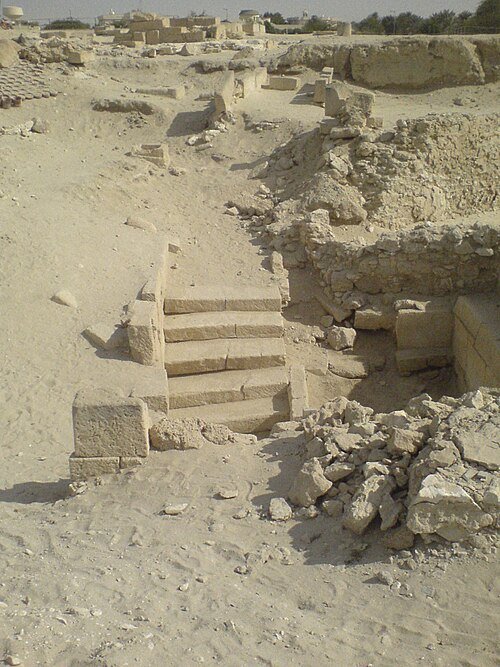
Archaeological remains at Barbar Temple. Photo: Graeme, Wikimedia Commons ↗, CC BY-SA 2.0 ↗. Display cropped to fit; archival photographs do not establish current access.
Look a little closer
The story behind the place.
The temple complex preserves phases of construction rather than a complete standing monument. Interpretation helps you make sense of the platforms and sacred water connection. It suits curious visitors who enjoy archaeology without expecting a reconstructed spectacle.
Archaeological remains at Barbar Temple. Photo: Graeme, Wikimedia Commons ↗, CC BY-SA 2.0 ↗. Display cropped to fit; archival photographs do not establish current access.
01
The temple complex
Three successive temples connect this village with the religious life of ancient Dilmun.
Plan your visitStay on the permitted visitor routes and leave archaeological stones undisturbed.
Use the sequence of temples to think about change over time. A plan or guide can make low remains more legible than a quick circuit without interpretation.
Archaeological remains at Barbar Temple, photographed in January 2008; not a view inside a sacred-water chamber. · Graeme · Wikimedia Commons · CC BY-SA 2.0. Display cropped to fit.
02
The sacred-water story
A sunken chamber associated with fresh water helps explain why this site mattered to its builders.
Plan your visitAsk the visitor service which features can currently be viewed, do not enter excavated chambers.
The photograph shows the temple remains as a whole, not permission to enter a chamber. Ask which parts of the sacred-water story can currently be viewed.
Bahrain National Museum exterior in Manama, photographed in 2008. A separate Manama visit, not a museum at Barbar. · Anthony DeCosta · Wikimedia Commons · CC BY 2.0. Display cropped to fit.
03
Put the finds in context
The National Museum in Manama offers a useful companion to an outdoor archaeology visit.
Plan your visitTreat it as a separately timed city stop, not a museum on the temple grounds.
The museum in Manama is a separately planned companion visit. Its interpretation can help connect a small outdoor site with the wider history of Dilmun.
A suggested outline
Take time to explore.
Read the site introduction before you arrive.
Explore the permitted route and allow time for the interpretation.
Continue towards Bahrain Fort only if your transport, opening times and energy allow.
Independent planning ideas, subject to travel advice, local access and opening arrangements.
Make the visit work for you
Plan a comfortable outing.
Allow time
45–90 minutes, suggested. This is our suggested planning allowance, not a published opening time.
Eat & drink
This is a short, exposed heritage stop. Bring water and plan refreshments elsewhere rather than relying on onsite food service.
Families, groups & accessible visits
Ask the venue about shade, toilets, steps and suitable routes before travel. For an organised group, confirm arrival slots, guide languages and coach access. We have not independently audited accessibility.
Choose a base, contact it directly
Where to stay.
Two base suggestions. Check location and transfers.
Direct hotel contact
The Westin City Centre Bahrain
A Seef-area base for excursions, connected to City Centre Bahrain.
Sheikh Khalifa Bin Salman Highway, Al Seef District, Manama, Bahrain
Fewer than 15 rooms? Contact the hotel directly. These published contacts are suggestions, not personal inspections, availability promises or confirmation of group capacity. Check operating arrangements before paying.
Large groups, 15 rooms or more
Ask ATA for low group hotel rates.
We use existing hotel agreements where available and negotiate for your group when needed, backed by over 35 years of group travel experience.
We respond within 48 hours, allowing for time zones worldwide. “Instant” rates do not always give you the lowest rates.
Arrange a return transfer from Manama or Seef. Check current site access before departing, and use the precise Barbar Temples location rather than the village centre.
Use the attraction contacts above for current visiting arrangements. Bahrain Tourism provides broader destination information, and the culture authority covers heritage sites.
Travel advisory and linked visitor/contact sources checked October 25, 2026. Check again before travelling, publication does not guarantee current access.