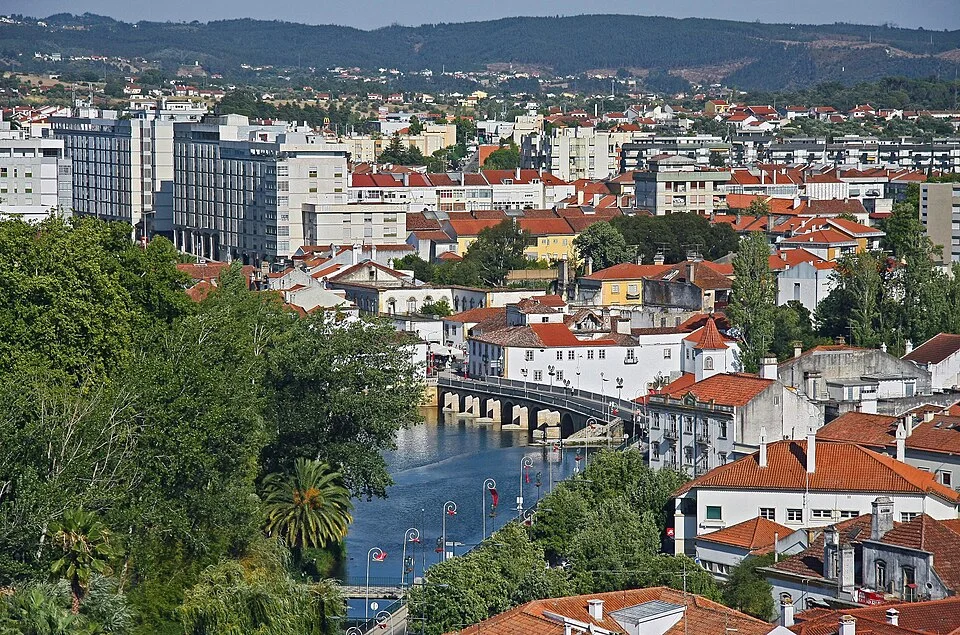
Tomar deserves more than a hurried convent stop. Its famous hilltop complex is the big invitation, but the streets below hold a synagogue, a handsome square and a river island made for an unhurried pause.
Tomar brings two landscapes into a small area: the fortified religious complex above the town and the Nabão running through its centre. The Templar foundation evolved into the great Convent of Christ, while the synagogue records the history of the Jewish community. Water links several of the remaining sights, from the Mouchão’s irrigation wheel to the aqueduct built to serve the convent.
Suggested stay: 2 nights. Adapt the pace to your interests.
Enlarge photoManueline exterior and Chapter Window at the Convent of Christ in Tomar. Photo: Kent Wang · Wikimedia Commons · CC BY 4.0. Cropped for display.
Convent of Christ
Current conservation notice: the monument lists access restrictions in several cloister, terrace and garden areas. Check the operator’s current list before assuming that every part of the complex is accessible.
The former Templar and Order of Christ complex brings together remarkable architecture and layers of Portuguese history. Allow proper time and check the current visiting circuit.
The complex begins with the Templar castle founded in 1160 and expands through the later Order of Christ. Its round Charola, Manueline church additions and Renaissance cloisters belong to different stages of that history. The celebrated Chapter Window makes maritime and royal imagery part of the architecture, while the surrounding buildings reveal centuries of enlargement.
Discover a different strand of Tomar’s history in the former synagogue. Check current opening and interpretation arrangements through the municipality.
Built in the fifteenth century, the synagogue has a compact vaulted interior supported by four columns and twelve wall corbels. It closed after the 1496 expulsion decree and later served several secular uses. Samuel Schwarz acquired the neglected building in 1923 and donated it to the state in 1939; today’s interpretation reconnects it with Tomar’s Jewish history.
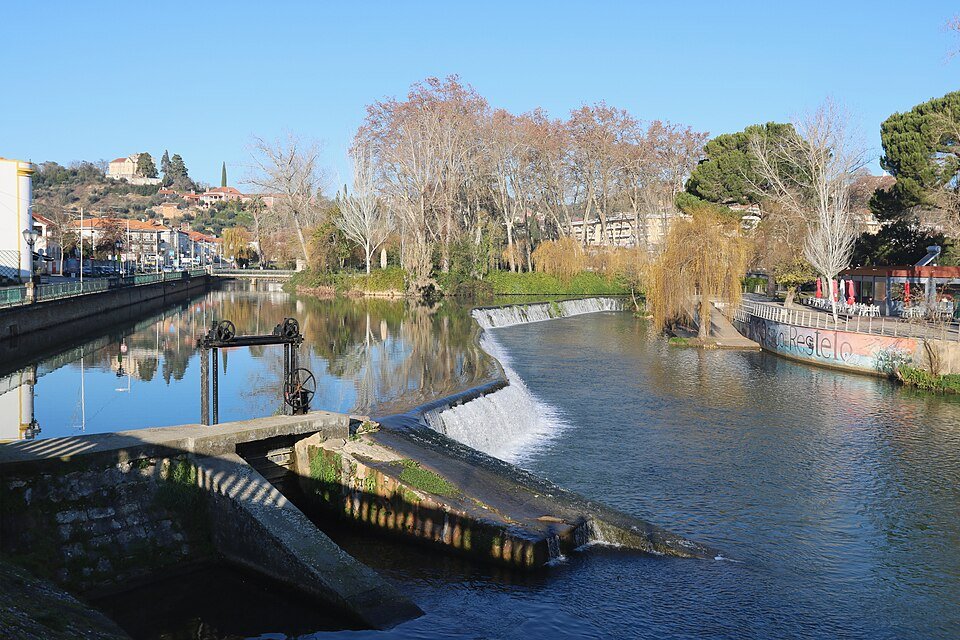
Cross to the river island for a gentler chapter after the convent. Keep children close by the water and enjoy the park as a local shared space.
Mouchão is a small garden island in the Nabão, linked to the town by pedestrian bridges. The large wooden irrigation wheel beside the weir recalls the river’s long practical role in watering fields and powering local activity. It is a maintained and reconstructed working structure, rather than an untouched survival from the distant past.
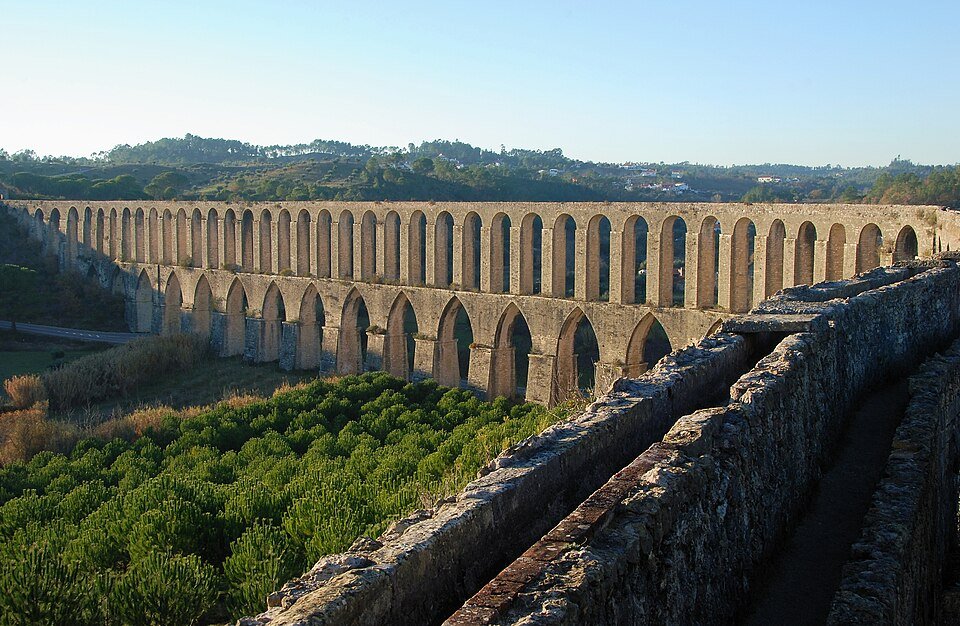
Look at the great aqueduct outside town as a separate outing. View it from safe public approaches, do not assume its elevated structure is an unrestricted walking route.
The Pegões Aqueduct belongs to the infrastructure of the Convent of Christ, carrying water across the surrounding terrain towards the religious complex. Long sequences of stone arches follow the route, rising into two tiers where the valley demands greater height. Its scale makes the convent’s dependence on an external water supply tangible beyond the monastery walls.
Check convent tickets and opening notices first. Smaller museum and synagogue arrangements can differ from the principal monument, especially outside the busiest season.
With children & at your own pace
Pair the convent with the riverside park. Break the uphill walk into manageable stages or take a transfer, and avoid planning four interiors in succession.
Access & getting around comfortably
The convent and aqueduct settings involve slopes and historic surfaces. Ask about the accessible circuit and entrance for your particular visit.
Season & conditions
Festival dates can transform a quiet town into a busy one. Reserve accommodation ahead of major events and keep summer hill walks out of peak heat.
Eat & drink
A LOCAL DINING OPTION
Restaurante Praça, Hotel República
A restaurant on the principal square, convenient after exploring the lower town. Confirm current service and book directly.
Fewer than 15 rooms? Contact the hotel directly. 15 rooms or more?Ask ATA for low group rates → We use existing agreements where available and negotiate for your group when needed. We respond within 48 hours, allowing for worldwide time zones.
Getting here & local help
Plan the last part too
Tomar is served by regional trains, check the connection rather than expecting every long-distance train to stop here. The convent stands uphill from the lower town.
Use the official resource below for local information, current visitor arrangements and tourism contacts. For a specific attraction or booking, contact its operator directly.
Written for ATA, published October 25, 2026. Official resources are linked beside the subjects they support. A live source link is not a guarantee that conditions will remain unchanged.