Thailand travel advice ↗ · Check regional restrictions, weather and air quality before travelling.
First-time highlight · Lower northern Thailand
Sukhothai
Lotus ponds, monumental Buddhas and time to slow down.
Sukhothai’s temples are best approached without hurry. Open spaces, water and surviving sculpture give the historical landscape a reflective character quite different from a busy modern city.
Sukhothai’s monuments preserve the artistic language of an early Siamese kingdom, where brick structures, stucco decoration and monumental Buddha images were designed to work together. The historical park is more than a collection of isolated ruins: its spaces and water features help reveal how the former capital was arranged. Slowing down makes those relationships easier to see.
Old Sukhothai and the modern town are different bases. Staying near the historical park can make early visits easier, while the monuments outside its central zone still need their own plan. Do not confuse the wider UNESCO property with one compact ticketed enclosure.
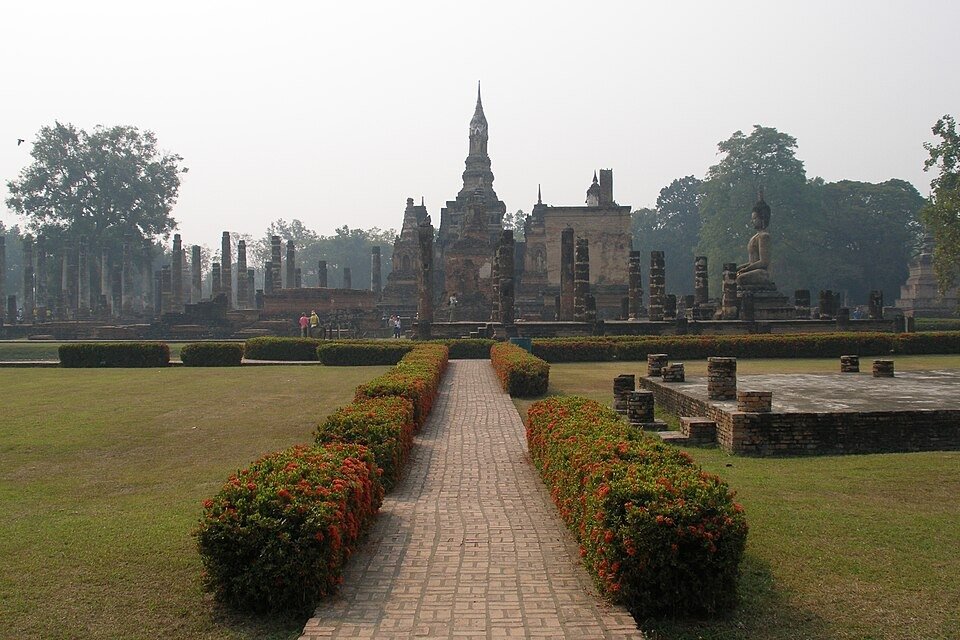
Enlarge photoThe ruins of Wat Mahathat in Sukhothai Historical Park. Photo: Vyacheslav Argenberg · Wikimedia Commons · CC BY 4.0. Resized; cropped for display.01
Wat Mahathat & the central park
Begin among the central-zone monuments, where temple remains and ponds establish the scale of the former city.
Wat Mahathat gives a strong introduction to the scale of Sukhothai’s religious architecture. Compare the surviving columns, chedis and Buddha images as parts of a planned ensemble rather than separate photographic subjects. The contrast between exposed brick and remaining sculptural surfaces also helps explain how much of the original decoration has disappeared from the buildings.
Plan your visitCheck the Fine Arts Department’s current zone and ticket arrangements, and leave time for shade and water.
A monumental seated Buddha creates one of Sukhothai’s most memorable encounters, in a separate part of the historic landscape.
Wat Si Chum is memorable for the enormous seated Buddha enclosed within a tall, thick-walled structure. The approach offers a restricted glimpse before the figure fills the visitor’s view, making the architecture part of the encounter. Notice the relationship between the calm facial modelling, the long fingers and the enclosing walls, rather than concentrating on size alone.
Plan your visitPlan the transfer from the central zone and follow posted access rules.
Where permitted, a short ride between selected monuments can turn ruins into a landscape rather than a succession of bus stops.
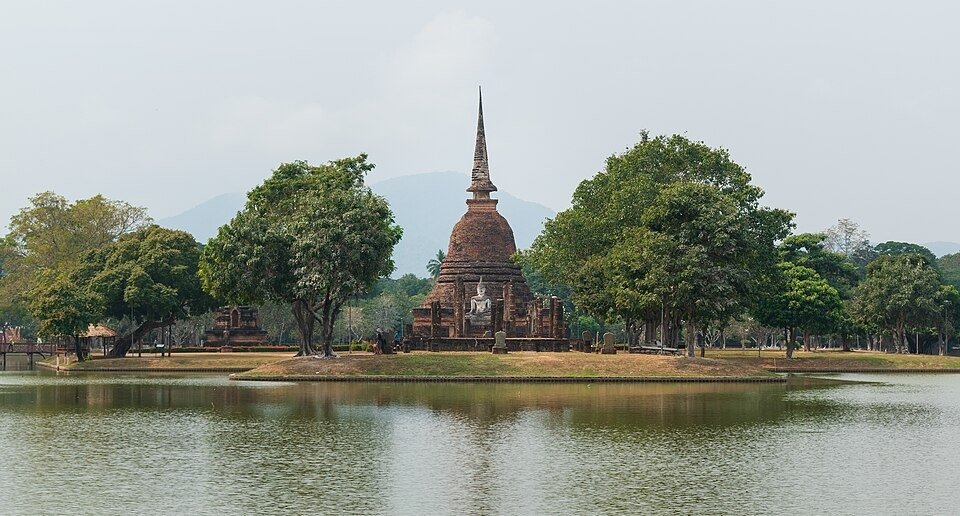
A bicycle circuit reveals the intervals between monuments: ponds, open ground and changing views that are easily lost on a rapid checklist tour. Wat Sa Si provides one example of a temple seen in relation to water and its surroundings. Keep the route selective so that the bicycle supports close observation, with time to stop and explore the architectural groups on foot.
Plan your visitChoose bicycles only if the route, surface, weather and your confidence suit it. A driver is an equally reasonable option.
Take a long lunch and rest, then choose a short ride or vehicle circuit.
See Wat Si Chum as a separate stop, allowing time to appreciate the sculpture.
Independent planning ideas, subject to travel advice, local access and opening arrangements.
Make the visit work for you
Plan a comfortable outing.
Allow time
2 days. This is our suggested planning allowance, not a published opening time.
Eat & drink
Look for Sukhothai-style noodles and ask the kitchen about their seasoning and toppings. A relaxed meal near your base is often preferable to squeezing in another distant monument.
Families, groups & accessible visits
Ask the venue about shade, toilets, steps and suitable routes before travel. For an organised group, confirm arrival slots, guide languages and coach access. We have not independently audited accessibility.
Season & conditions
Open-ground sightseeing can be very hot. Carry water, plan around storms and check regional air quality in the dry season.
Fewer than 15 rooms? Contact the hotel directly. These published contacts are suggestions, not personal inspections, availability promises or confirmation of group capacity. Check operating arrangements before paying.
Large groups, 15 rooms or more
Ask ATA for low group hotel rates.
We use existing hotel agreements where available and negotiate for your group when needed, backed by over 35 years of group travel experience.
We respond within 48 hours, allowing for time zones worldwide. “Instant” rates do not always give you the lowest rates.
Confirm whether your hotel is in Old Sukhothai or the modern town. Flights and long-distance buses require onward transfers; rail travellers commonly connect through another city rather than arriving at the ruins.
Use the official destination resource below for local background, then contact the tourism office or attraction about current visiting arrangements and guides.
Published October 25, 2026. Sources are linked for visitor information and hotel contacts. Confirm changing arrangements before travel.
Practical answers
Planning your Sukhothai visit.
Should I stay in Old Sukhothai or the modern town?
For a visit focused on the ruins, an Old Sukhothai base reduces the need to travel out from the modern town each day. The two hotel suggestions below follow that approach. Compare the hotel location with your bus, airport or other arrival transfer before booking.
Do I need a bicycle to visit Sukhothai?
A bicycle is one possible way to explore, not a requirement. Match your route to confidence, heat and conditions, and ask locally about alternatives. Wat Si Chum is a separate stop from the central temple group, so plan the whole outing and check any separate admission arrangements.
Put the places together
Continue your Thailand journey.
Choose a connection that fits your route and allow time to travel between bases.
Written and maintained by the American Tour Association. Planning text and links reviewed November 1, 2026. Suggested stays and route combinations are editorial guidance, not transport schedules or guarantees of access.