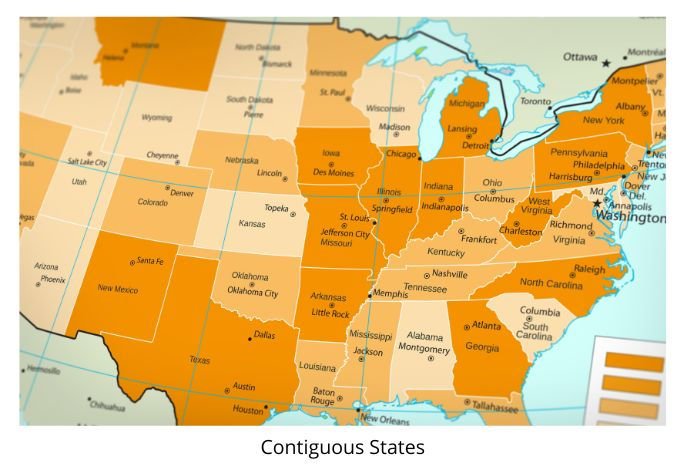
The term "contiguous states" refers to the 48 states that
are located on the North American mainland and are connected together, forming a
continuous land border with each other. These states are sometimes also referred
to as the "lower 48" or "conterminous United States" to distinguish them from
the non-contiguous states of Alaska
and Hawaii.
The contiguous states span from the Atlantic Ocean on the east coast to the
Pacific Ocean on the west coast. They are bordered by Canada to the north and
Mexico to the south. These states include popular destinations such as
California, New York, Texas, Florida, Illinois, and many more.
The term "contiguous" simply means "sharing a common border" or "touching each
other without interruption." In the case of the contiguous states, it means that
they are all geographically connected to one another, forming a continuous
landmass within the United States.
The contiguous states are home to a diverse range of landscapes, cultures, and
attractions. From the bustling cities to vast rural areas, visitors can explore
everything from stunning coastlines and majestic mountains to rolling plains and
lush forests. Each state within this region has its own unique characteristics,
landmarks, and points of interest, making it a rich and varied part of the
United States to discover.
Home | States/Provinces | Subjects