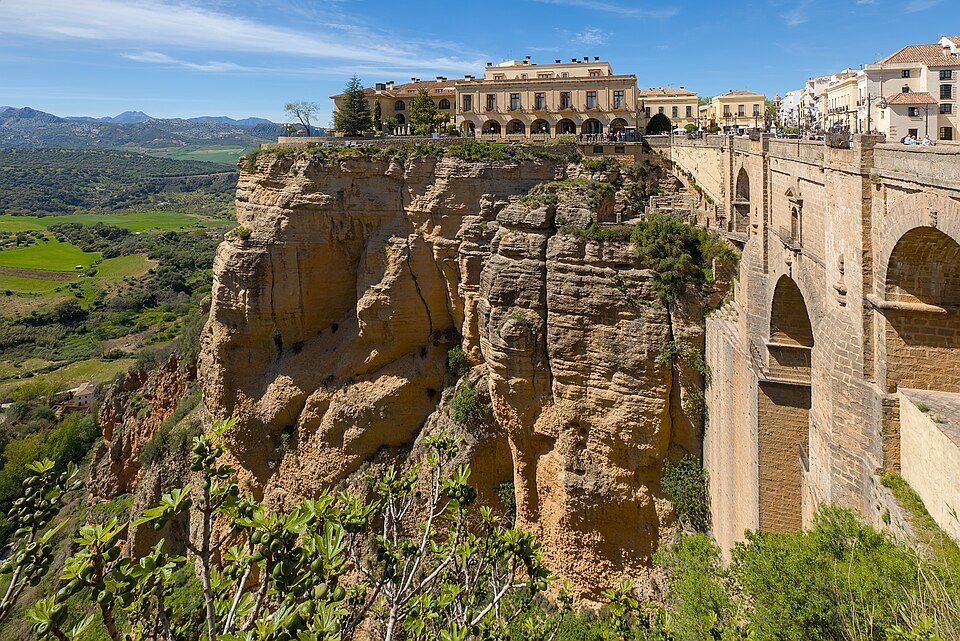
Ronda’s gorge is its most dramatic feature, but the town’s history is also written in bridges, baths, palaces and public buildings. The Puente Nuevo links neighbourhoods across the ravine, while quieter architectural spaces reveal different aspects of life on either side.
Understand the place
Ronda: history & setting
The Guadalevín gorge divides the historic town from the later Mercadillo quarter, creating both a natural defence and a challenge for urban growth. Islamic-period remains, including the baths, preserve part of Ronda’s earlier fabric. Later aristocratic patronage reshaped civic life and architecture. The eighteenth century produced the Puente Nuevo and the bullring, two monuments that became defining symbols of the town. The palace of Mondragón adds a more intimate story through its courtyards, decorated interiors and successive alterations.
More about Ronda & original local links
Spanning Time and Ravine, Ronda - The Soul of the Sierras
In the heart of Andalusia, perched high atop the El Tajo gorge, there is a city where the echoes of the past reverberate against rugged cliffs and through narrow cobbled streets.
This is Ronda, a city carved by time, where history, culture, and breathtaking natural beauty come together to create a destination that is as compelling as it is enchanting.
Ronda invites you to walk along the edge of the world, across the Puente Nuevo, a stone bridge spanning the gorge that provides a vantage point like no other. From here, the city unfurls on one side, while on the other, the Serranía de Ronda stretches into the distance, a patchwork of olive groves, vineyards, and whitewashed villages. As you cross, pause for a moment, feel the pulse of the Guadalevín River far below, listen to the whispering wind that carries tales of Ronda's storied past.
And what stories this city has to tell. Ronda is a city shaped by the Romans, the Moors, and the Christian Reconquest, a city whose soul is woven from the threads of diverse cultures. Discover this rich tapestry in the city's historic quarter, where the Church of Santa Maria la Mayor stands on the site of a former mosque, and the Palacio de Mondragon houses a museum that traces Ronda's history back to the Neolithic era. Explore the ancient Arab Baths, the best preserved in Spain, their tranquility belying the hustle and bustle of the world outside.
Ronda is also a city of passion, the birthplace of modern bullfighting. The Real Maestranza bullring, one of the oldest and most picturesque in Spain, bears testament to this heritage. Even if bullfighting stirs controversy, the beauty of the ring and its accompanying museum speaks of a tradition that has played a significant role in Spanish culture.
Yet Ronda is not trapped in the past. Today, it is a city of vibrant festivals, such as the colorful Feria Goyesca, of innovative wineries producing top-notch wines in the surrounding countryside, and of restaurants where Andalusian culinary traditions are given a modern twist. Wander through the city's newer Mercadillo quarter, where lively tapas bars spill onto sun-dappled squares, and you'll find a city that embraces the future without forgetting its roots.
Ronda's greatest charm, however, lies in its ability to make you feel as if you've stepped into another world, one where the pace is slower, the air sweeter, the vistas more stunning. Whether you're savoring a glass of local wine while watching the sunset paint the cliffs in hues of gold, or strolling along the Alameda del Tajo, a leafy promenade offering unparalleled views of the countryside, Ronda has a way of captivating the heart.
Ronda is more than just a city; it's an experience, a step back in time, a feast for the senses. So come, let Ronda enchant you, let its beauty stir your soul, and let its spirit leave an indelible mark on your heart.

 Enlarge photo


