Entrance pavilions in Park Güell, Barcelona
American Tour Association · Spain

Barcelona

Enlarge photo
Entrance pavilions in Park Güell, Barcelona. Photo: Bernard Gagnon. 2009 · Wikimedia Commons · CC BY-SA 3.0. Converted to sRGB/JPEG; display crop.

Barcelona rewards looking closely: a medieval cathedral, Gaudí’s experimental forms and a former hospital conceived as a garden city each reveal a different idea of urban life. These landmarks are distinct places with separate histories, not interchangeable examples of a single architectural style.

Understand the place

Barcelona: history & setting

The city’s architectural contrasts are especially clear between its Gothic centre and the Modernista buildings created during its later expansion. The Sagrada Família began in 1882; Gaudí took over the following year and radically developed the project. Park Güell began as a residential venture rather than a conventional municipal park. Sant Pau, meanwhile, united hospital care with gardens, ornament and carefully planned pavilions. Its healthcare activity moved to a new building in 2009, allowing the restored historic ensemble to take on a cultural role.

Look a little closer

Places to discover in Barcelona

Western exterior of the Sagrada Família apse, BarcelonaEnlarge photo
Western exterior of the Sagrada Família apse, Barcelona. Photo: Didier Descouens. 2018 · Wikimedia Commons · CC BY-SA 4.0. Converted to sRGB/JPEG; display crop.

Sagrada Família

The temple began with a nineteenth-century neo-Gothic project before Gaudí developed his own structural and symbolic language. The apse, branching forms and richly worked façades belong to a building created over many generations. Construction and visitor arrangements continue to evolve, so use the basilica’s own information for the route available during your visit.

Official history & visitor information ↗
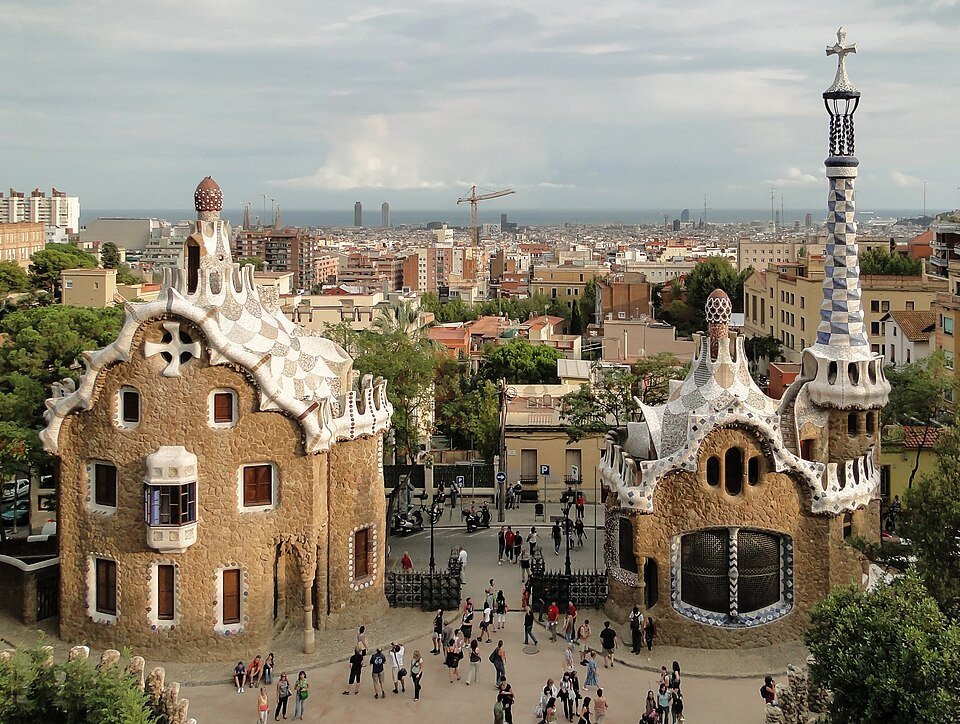
Entrance pavilions in Park Güell, BarcelonaEnlarge photo
Entrance pavilions in Park Güell, Barcelona. Photo: Bernard Gagnon. 2009 · Wikimedia Commons · CC BY-SA 3.0. Converted to sRGB/JPEG; display crop.

Park Güell

Gaudí’s collaboration with Eusebi Güell grew from an intended residential development on the hillside into one of Barcelona’s best-known public landscapes. Architecture and terrain are deliberately connected: paths, supports and ornamental structures respond to the slope rather than imposing a simple flat plan. The entrance pavilions in the photograph introduce this unusual relationship between building and garden.

Official history & visitor information ↗
Barcelona Cathedral façadeEnlarge photo
Barcelona Cathedral façade. Photo: Jose María Ligero Loarte. 2019 · Wikimedia Commons · CC BY-SA 4.0. Converted to sRGB/JPEG; display crop.

Barcelona Cathedral

Construction of the present Gothic cathedral began in 1298 above earlier religious buildings. The main body took shape during the medieval period, but the elaborate façade and central spire are later: the façade campaign began in the nineteenth century and the upper work was completed in 1913. That difference explains why the front and interior can feel like related but distinct architectural chapters. The cloister was finished in 1448.

Official history & visitor information ↗
Domes and rotundas of Sant Pau pavilions, BarcelonaEnlarge photo
Domes and rotundas of Sant Pau pavilions, Barcelona. Photo: Bernard Gagnon. 2009 · Wikimedia Commons · CC BY-SA 3.0. Converted to sRGB/JPEG; display crop.

Sant Pau Art Nouveau Site

Lluís Domènech i Montaner conceived the Modernista hospital as a coordinated ensemble of pavilions, gardens and decorative arts. Construction continued under his son Pere, and the complex was inaugurated in 1930. Healthcare moved to a modern building in 2009; restoration then opened a new chapter for the historic site. Its carefully worked roofs and façades express the belief that light, greenery and beautiful surroundings could contribute to care.

Official history & visitor information ↗
More about Barcelona & original local links

Barcelona: The Essence of Mediterranean Magic

Barely a heartbeat away from the crystalline expanse of the Mediterranean Sea, cradled in a crook of Catalonia's undulating landscape, Barcelona unfurls before you like an enchanting palimpsest of history, innovation, and irresistible charm.

With its vibrant patchwork of Gothic spires, Gaudí masterpieces, and glittering beaches, this city is a symphony composed in the key of beauty and wonder, waiting for you to step into its sun-drenched melody [keep reading]

Basilica of Sagrada Familia, an awe-inspiring fusion of architecture and spirituality that stands as a testament to human creativity and ingenuity.

This iconic, unfinished masterpiece by Antoni Gaudí is one of the most visited monuments in Spain. It's a spectacle of modernist architecture with its intricate facades and impressive interior. Visit here

Park Güell, a mesmerizing garden crafted by the imaginative genius of Gaudí

A public park system composed of gardens and architectural elements, sprung from the mind of Gaudi, offers beautiful views over the city. Visit here

Explore another city in Spain →