Seville has the grand entrance down to an art: a palace courtyard, a soaring bell tower, a square that seems designed for a film. Stay a little longer and the smaller things begin to compete—painted tiles, a shaded patio, a bridge crossed without a timetable.
The cathedral, Alcázar and Archivo de Indias form a UNESCO World Heritage ensemble. Together they tell a story of Islamic and Christian rule, royal ambition and Seville’s role in the Spanish empire’s overseas trade. The city is most rewarding when those layers remain visible, rather than being reduced to a single golden age.
The Alcázar is a sequence of palaces, courtyards and gardens shaped by successive rulers. Its history reaches back to an early Islamic seat of government; the fourteenth-century palace of Pedro I is a remarkable expression of Mudéjar design under a Christian king. Look at the tilework, carved surfaces and repeated arches as parts of a carefully composed whole.
In the Patio de las Doncellas, give yourself time to notice how water and architecture frame one another. Then slow down again in the gardens. This is a place that rewards looking twice, even when the camera thinks it finished on the first lap.
Plan your visitReserve through the link on the official Alcázar website. Check the exact ticket, entry time, identification requirements and access arrangements before paying. Leave a generous gap before your next booked visit. Official Alcázar visitor information ↗
The Giralda makes Seville’s layered history visible in one tower: its lower section belongs to the former mosque’s minaret, while the upper bell stage expresses the later cathedral. Inside the cathedral, Gothic scale and an extraordinary accumulation of art demand a slower pace than a quick glance from the doorway.
Afterwards, walk into the lanes of Santa Cruz rather than immediately joining another queue. Keep to public streets, notice the change in shade and sound, and let a small square become a pause. The neighborhood is lived in; an open gate is not automatically an invitation into a private courtyard.
Plan your visitUse the cathedral’s official cultural-visit information for tickets and current entry arrangements. Ask about the Giralda route and physical demands separately from ground-level cathedral access; worship can affect visits. Official cathedral & Giralda visits ↗
This apparently timeless landmark belongs to the twentieth century. Designed by Aníbal González for the Ibero-American Exposition of 1929, Plaza de España combines a sweeping building, a canal, bridges and tiled provincial scenes into one theatrical gesture. Walk the arcades as well as the open square: details are easier to appreciate when the sun is not in your eyes.
The tiled benches turn a broad panorama into dozens of small stories. Look closely, then continue into María Luisa Park for a change of rhythm. An early or later visit can be more comfortable in warm weather; keep water and a shaded break in the plan.
Plan your visitApproach on foot from the historic centre or use local transport to the park area. Check event notices and temporary restrictions. Boat hire and other activities have their own operating arrangements. Official Plaza de España guide ↗
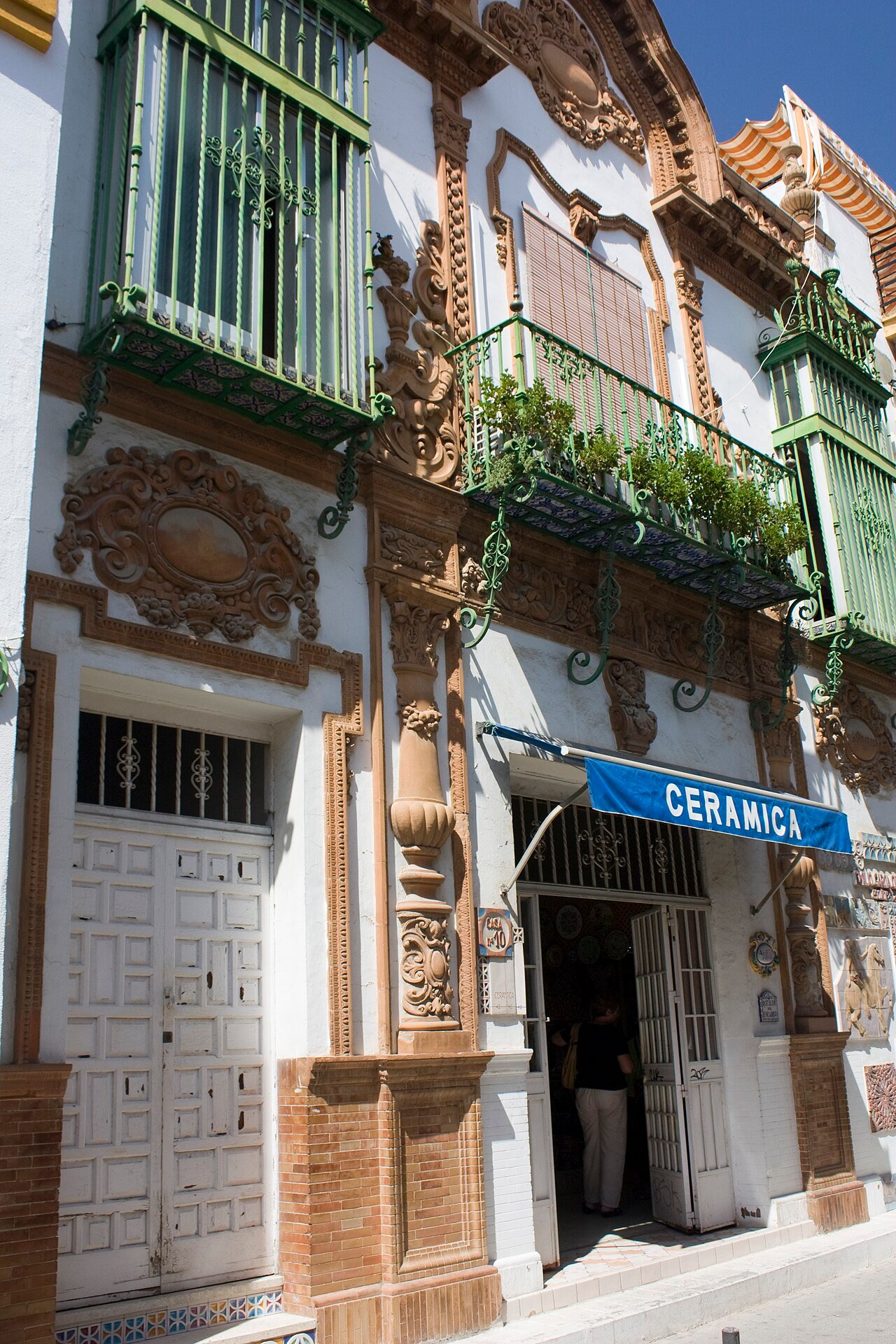
Enlarge photo ↗A historic ceramics-workshop façade in Triana; an illustration of the neighborhood’s craft heritage.Photo: Daniel Villafruela. · Wikimedia Commons ↗ · CC BY-SA 3.0 ↗. Fitted/cropped for display.
04 · LOOK A LITTLE CLOSER
Triana: follow the story in the tiles
Cross the Guadalquivir and make ceramics the thread of your Triana visit. The Centro Cerámica Triana occupies the former Santa Ana factory and interprets the work behind the city’s decorated surfaces, including historic kilns. After the grand monuments, it is a satisfying way to understand how beauty was actually made.
Continue through the public streets around San Jorge and Antillano Campos, then head toward the river. Ask shops about makers and production rather than assuming every colorful piece was made locally. The photograph shows a workshop façade in the neighborhood, not the museum entrance or a promise that the pictured shop is open today.
Plan your visitThe map below locates Centro Cerámica Triana, the recommended starting point. Verify current museum access through the city’s heritage information; workshop or shop visits require separate arrangements. Official municipal heritage information ↗
Casa de Pilatos is a sixteenth-century palace where classical sculpture, arcades and richly patterned decoration share the stage. It offers another way into Seville’s palace culture: more intimate than the royal complex, with a courtyard that encourages you to compare one surface with the next.
Come for the relationship between materials as much as for individual masterpieces. Stand back for the geometry, then move closer for a tile border or carved detail. Add it as a deliberate detour on a second day rather than squeezing it between two timed tickets.
Plan your visitThe palace is at Plaza de Pilatos, 1. Check the operator’s current visiting arrangements, including which floors your chosen visit covers; upper-level access should not be assumed. Fundación Casa Ducal de Medinaceli ↗
Built between the fifteenth and sixteenth centuries, Las Dueñas has belonged to the House of Alba since 1612. Its patios, gardens and domestic spaces tell a different story from a public square: how a great house was lived in, adapted and remembered. The poet Antonio Machado was born here in 1875, when his father was among the residents associated with the property.
Treat this as a less obvious stop, not a secret that nobody else knows. Spend time on the transition from rooms to garden and on the changing light beneath the galleries. If the major sights are Seville’s headline, this is a very good paragraph farther down the page.
Plan your visitUse the palace’s own website for tickets, hours and any restricted spaces. Confirm current access needs and group arrangements in advance. A historic house can have a more limited visiting route than its exterior suggests. Official Palacio de las Dueñas website ↗
Book the Alcázar as your main visit. Add a Santa Cruz stroll and a proper lunch break. Fit the cathedral into the day only if the confirmed times leave enough breathing room.
A different scale
Visit Casa de Pilatos or Las Dueñas, then spend time around the surrounding streets. Later, cross to Triana for the ceramics story and a river walk.
Light & open space
Give Plaza de España and María Luisa Park an unhurried morning or later afternoon. In hotter weather, move the longest outdoor walk away from the midday sun.
Eating & an evening out
Leave something unplanned.
For tapas, choose a short menu that appeals to you and order gradually rather than turning dinner into another checklist. Ask about portions, ingredients and the day’s dishes. For flamenco, choose a programmed performance and check its length, seating and booking conditions; a street performance is a different experience.
A little practical sense
Comfort matters.
Old paving, crowded lanes and exposed squares can make short distances feel longer. Wear comfortable shoes, carry water and plan shaded breaks. Ask venues about step-free routes before booking. Semana Santa and Feria periods deserve an early check of accommodation, transport and access plans.
A place to put down your bags
Where to stay.
Public business contacts for your convenience. Confirm availability, rates, access and room arrangements directly with the property. Inclusion does not establish ATA membership.
Direct accommodation contact
Hotel Amadeus
A historic-centre base for exploring the cathedral and Santa Cruz area. Confirm which entrance to use, room access and arrival arrangements directly.
A central option on the river side of the old town, useful for a stay that includes Triana. Ask the hotel about parking, drop-off arrangements and your room requirements.
Santa Justa is the main rail arrival point for many visitors. From Seville Airport, the EA bus provides a city connection; check the current route and service with Aena or TUSSAM. Arrange a taxi or onward local transport as needed rather than assuming your hotel is beside the arrival stop.
The centre is best approached as a series of walks, with local transport between longer stops. Ask your hotel about legal vehicle access and parking before driving into the old town. Groups should arrange coach drop-off and pedestrian meeting points in advance.
Use the city tourism office for current guides, maps, events and visitor information. Book monuments through links supplied by their official operators, and check which spaces your ticket includes.
Researched 13 November 2026. Suggested routes are editorial ideas, not a packaged tour or a guarantee of entry. Opening, prices, access and hotel details may change. Original photographs open through each Enlarge photo link; author, source and license appear beside each image.


 Enlarge photo ↗